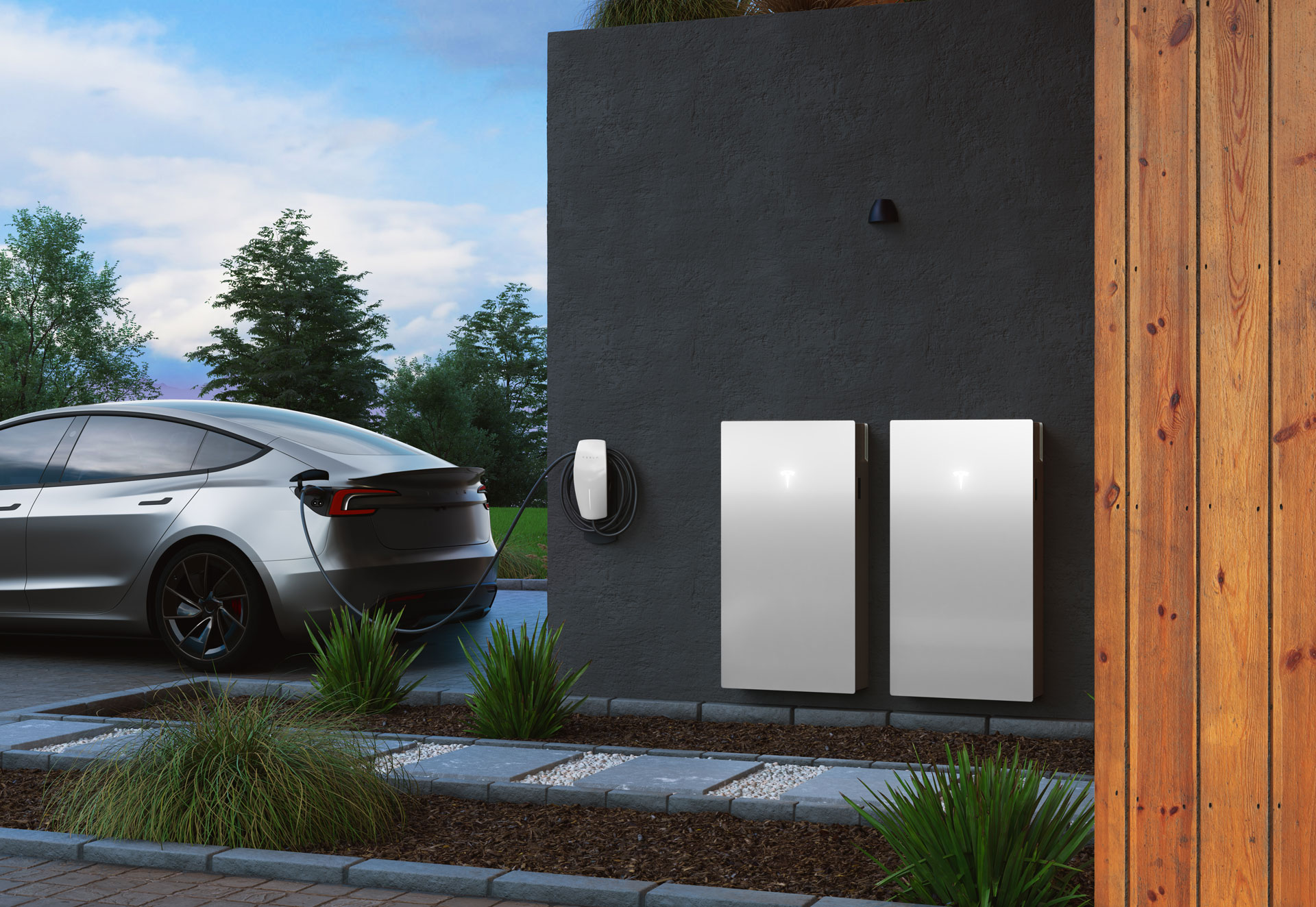
One box. Whole house. No extra inverter.
Powerwall 2 needed a separate solar inverter sitting next to it. Powerwall 3 doesn't. Tesla built a hybrid inverter directly into the unit, with three independent MPPTs accepting up to 20 kW of DC solar — which means you can run east-, north- and west-facing strings on a single Powerwall and harvest each one independently. For most Australian homes installing solar and battery together, this collapses two products and two install bills into one.
The other quiet upgrade is starting current. 11.04 kW continuous AC output with motor-starting capability up to 185 A LRA means it'll start a ducted air-con compressor or a pool pump off-grid without flinching — something Powerwall 2 and most of its competitors struggle with.
Highest continuous output in class
11.04 kW AC per unit — meaningfully more than most 13 kWh competitors. Runs ducted reverse-cycle on backup.
Three MPPTs, 20 kW DC solar
Run east/north/west strings independently — ideal for split-roof Australian homes.
100% depth of discharge
You actually get 13.5 kWh out of 13.5 kWh, every cycle. LFP chemistry, no software gating.
Tesla app + Storm Watch
Best-in-class monitoring. Auto-charges to 100% before forecast storms or extreme weather.
The numbers, in full.
- Usable energy
- 13.5 kWh (100% depth of discharge)
- Continuous power (AC)
- 11.04 kW on-grid & backup
- Motor-starting
- 185 A LRA — ducted AC, pool pump capable
- Battery chemistry
- Lithium iron phosphate (LFP) — cobalt-free
- Integrated inverter
- Yes — hybrid, 3 MPPTs, up to 20 kW DC solar input
- Backup
- Whole-home backup compatible (with Tesla Gateway)
- Scalability
- Up to 3 units in parallel — 40.5 kWh, 33 kW
- Dimensions
- 1,105 × 609 × 193 mm
- Weight
- ~124 kg (132 kg with bracket & cover)
- Operating temperature
- -20 °C to 50 °C
- Warranty
- 10 years · 70% capacity retention
- Certification
- AS/NZS 5139, CEC-approved
The right call when…
The Powerwall 3 is the default recommendation for most homes installing solar + battery together for the first time. The integrated inverter saves money and wall space; the high continuous output handles modern loads; the Tesla app is genuinely the best in the category.
- You're installing solar and a battery together (the built-in inverter saves $1.5–2.5k)
- You run ducted reverse-cycle, a pool pump, or want EV-charging from the battery on backup
- You have a split-roof home (3 MPPTs let each face do its own thing)
- You value app experience and software updates over absolute lowest cost
Where it falls short.
One size only. 13.5 kWh — no modular sizing. If you only need 8 kWh, you're paying for capacity you won't cycle for years; if you need 25 kWh, you're stacking two whole inverters you don't need. Anker SOLIX X1 and Sigenergy SigenStor are more flexible if your demand sits outside the 12–18 kWh sweet spot.
Internet dependency for the warranty. Tesla's 10-year warranty is contingent on the unit staying connected to the internet so it can phone home. Most installs are fine; rural homes with patchy 4G should plan for this.
Retrofitting onto an existing solar system. If you already have a working solar inverter you're happy with, you're paying for a second inverter inside the Powerwall that you can't use. AC-coupled options like the Enphase IQ Battery 10C are cleaner retrofits.